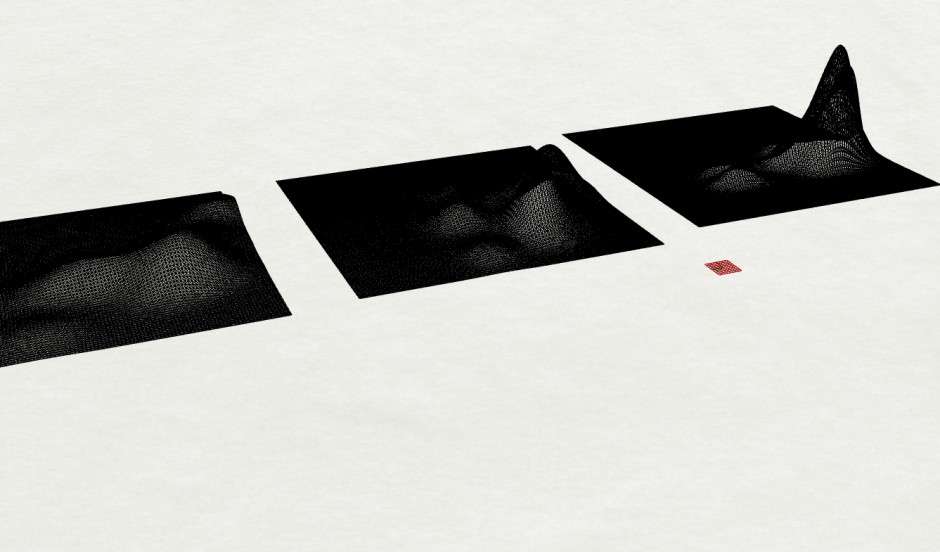
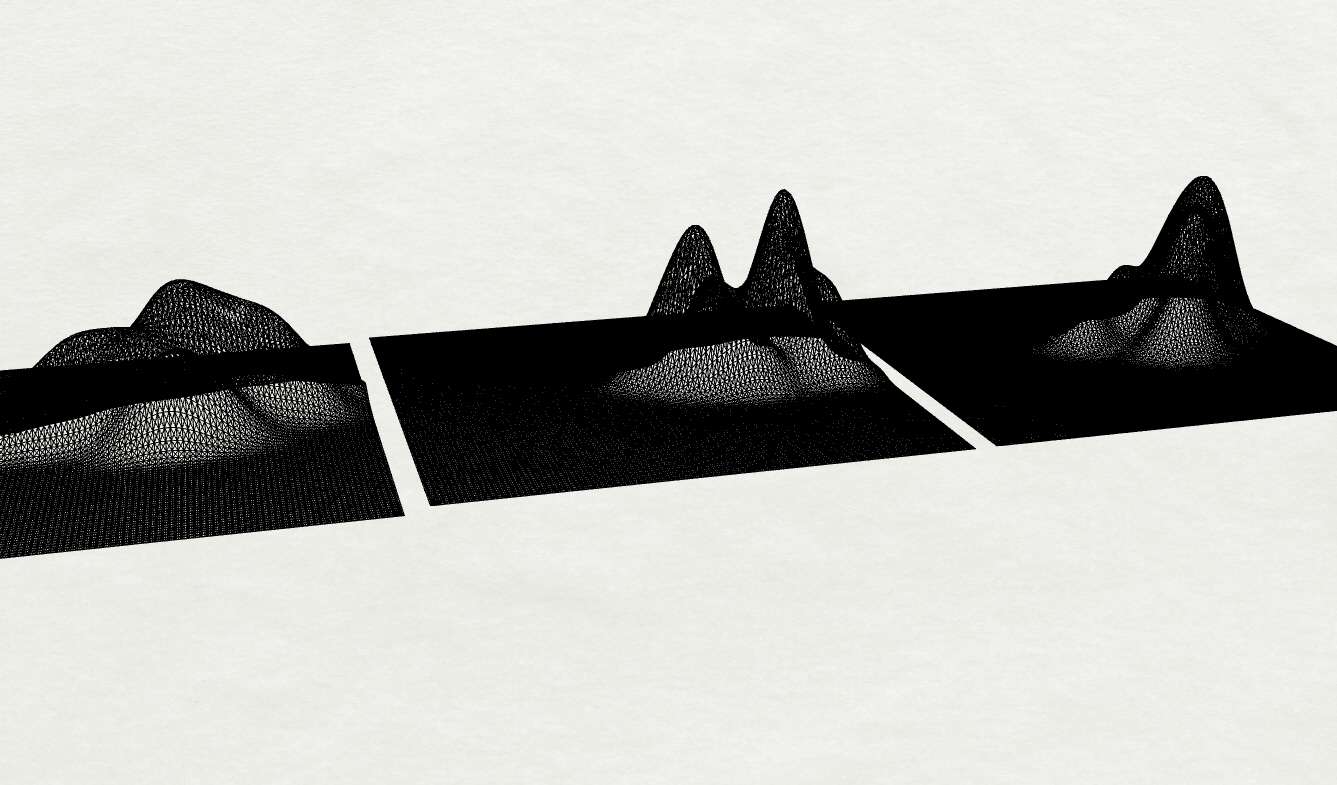
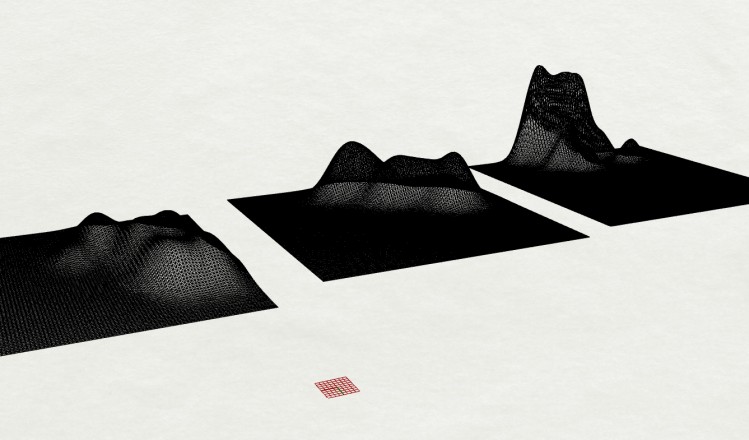
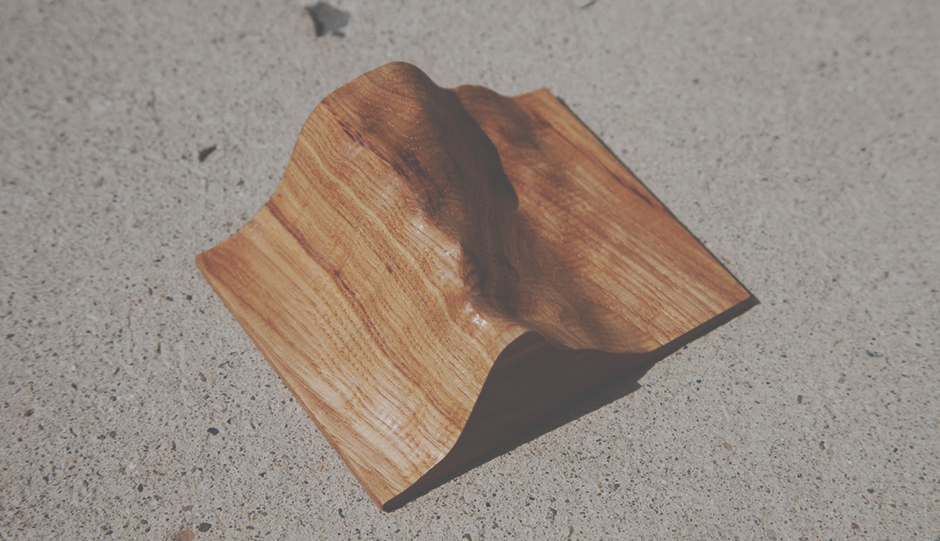
Biobehavioral Landscapes is a 3D data visualization of emotion data collected over time. One hundred fifty adults aged 18 to 90 provided reports about their daily lives, interactions, feelings, and health for nine weeks between May 2010 and September 2011 — in vivo, in real time.
Overview
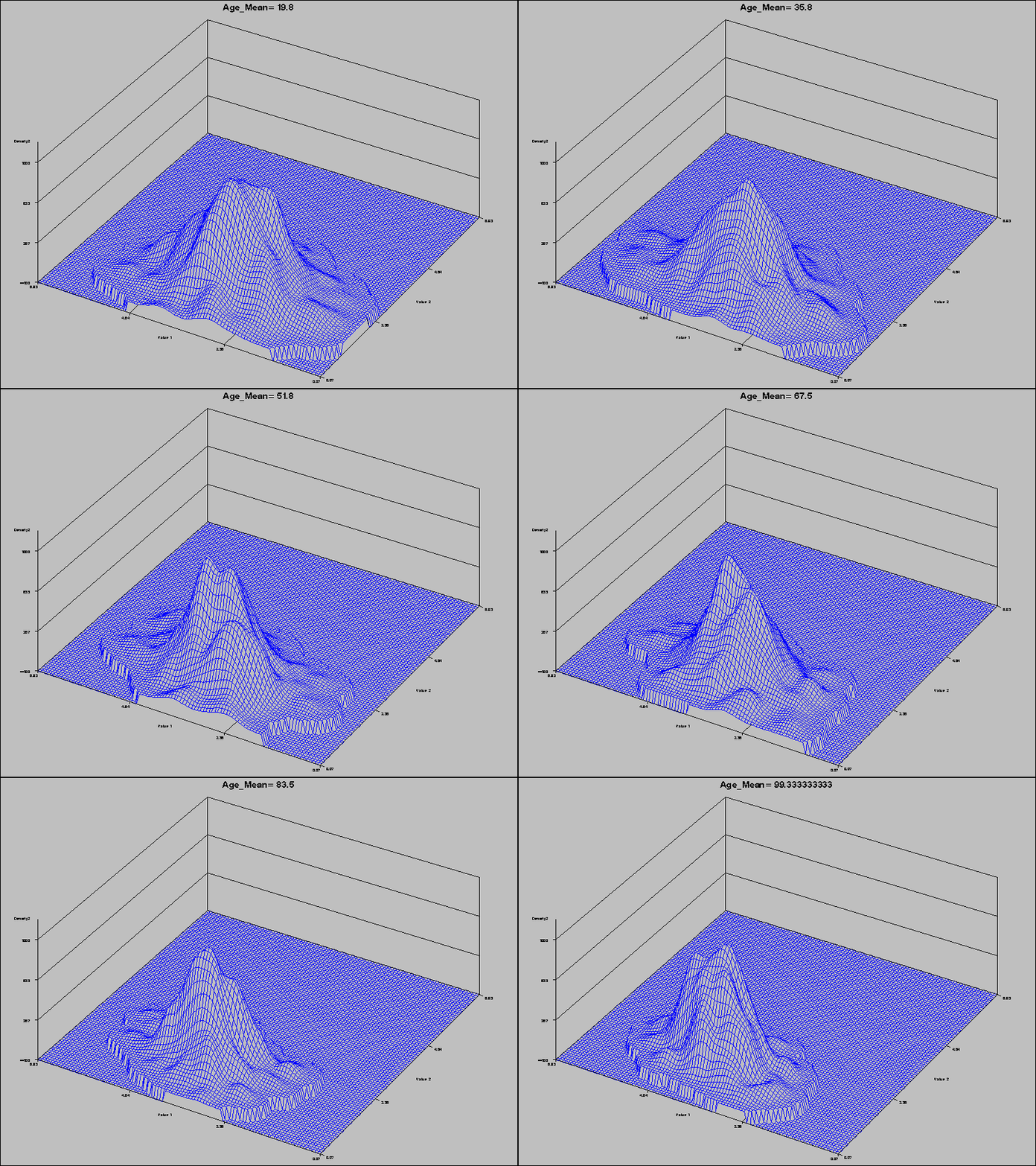
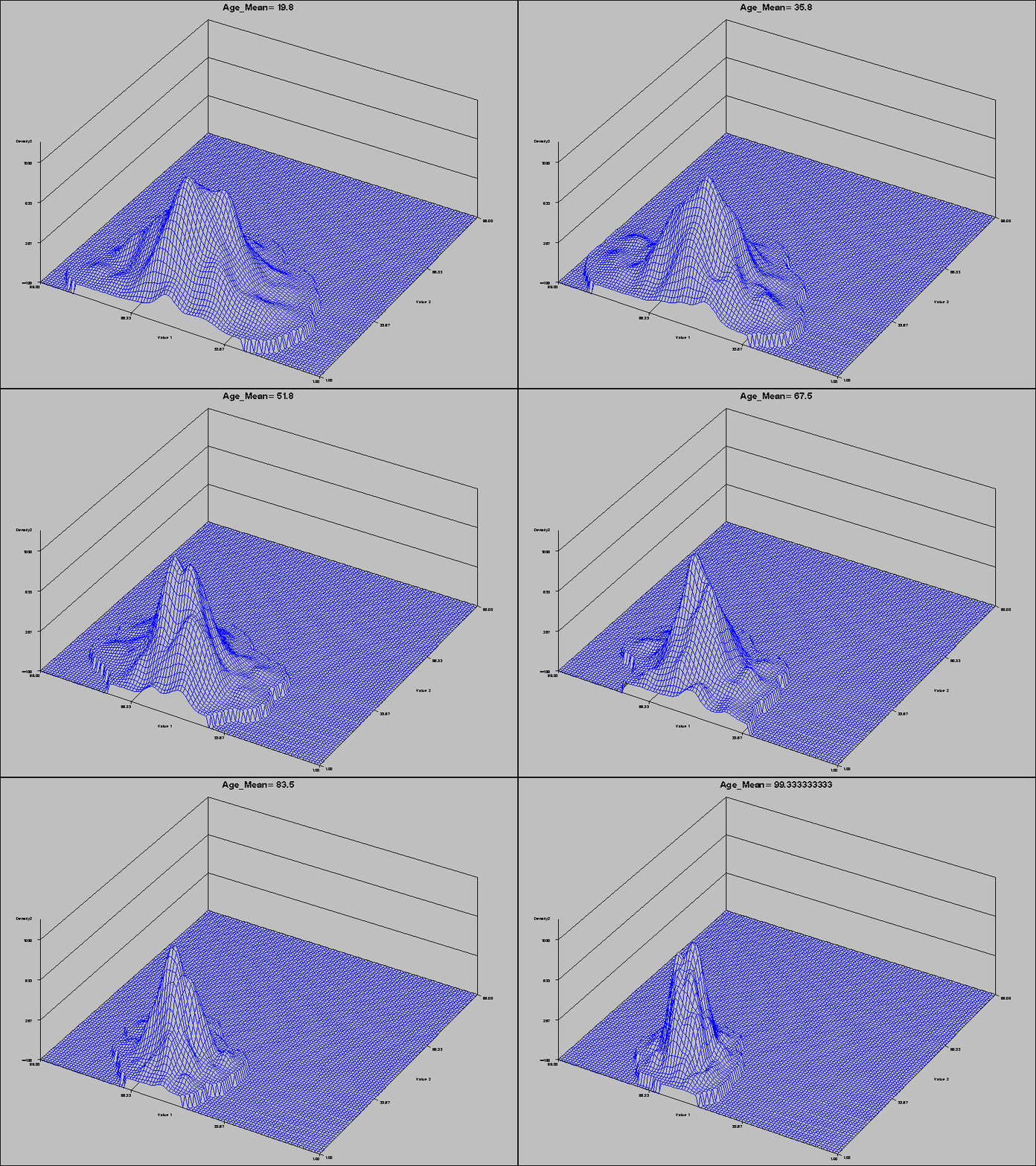
In a paper by Ram et al. (2013), we described 3D rendered images of multivariate density distributions as behavioral landscapes and examined the possibility that these landscapes change as an individual transitions through life events. The landscape of each person, we surmise, can be interpreted as (a) a description of the individual, (b) a description of the person's environmental context — since they "live" within the hills — or (c) a description of the person-context transactions. In each case, the landscape can be shaped by large external events: marriage, the birth of a child, retirement, illness, or loss.
In this 3D distribution, an individual's behavior "resides" within the hills. Visualized this way, we can immediately see similarities between the density distributions and the natural world — mountains, hills, and plains — and may be reminded of the many theoretical perspectives that describe behavior and developmental landscapes. The topography encodes the frequency and intensity of emotional states: tall peaks represent emotional configurations that a person inhabits frequently and intensely, while flat valleys represent rare or muted states.
From Data to Physical Object
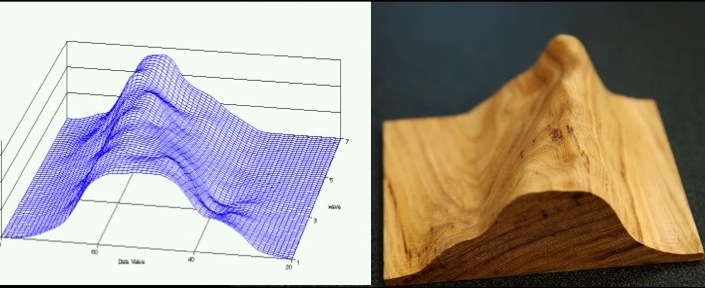
The visualizations were created in Rhino using Grasshopper, a visual parametric programming language. Grasshopper allowed us to take the raw multivariate density data and generate smooth, continuous surface meshes that faithfully represent the underlying distributions while producing geometry suitable for physical fabrication.
The digital models were then carved on a five-axis CNC mill from solid oak. The transition from screen to material adds a dimension that the digital rendering cannot fully convey: the physical sculptures have weight, grain, and texture. Running a hand across the surface, one can feel the ridges and valleys of a person's emotional life — the sharp peaks of frequent high-arousal states, the broad plateaus of sustained calm. The choice of oak was deliberate: its grain and warmth give the abstract statistical forms an organic, almost geological quality.